
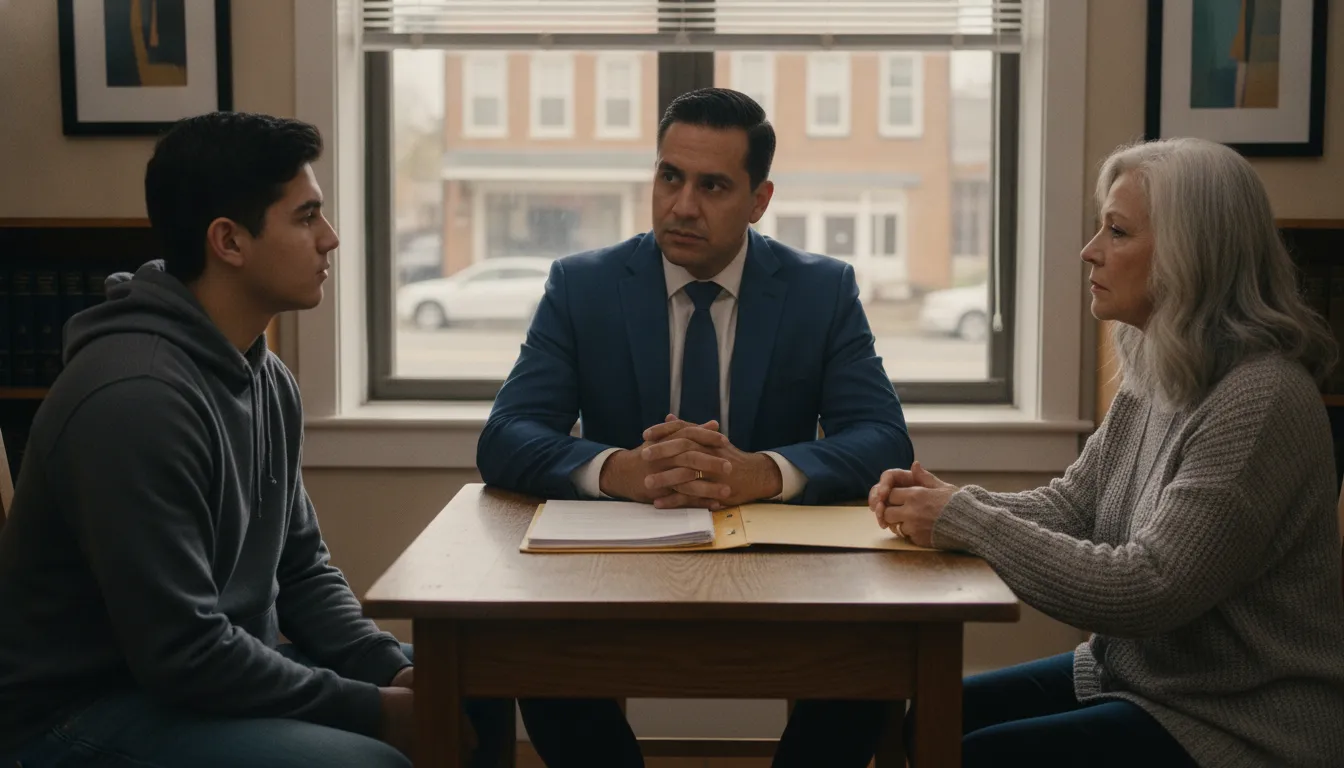
A young person facing parental abuse, abandonment, or neglect may need help from two systems. A Maryland court makes the state-law findings. U.S. Citizenship and Immigration Services decides the immigration petition.
Special immigrant juvenile status may be available to some unmarried people under 21 who are in the United States. They need a qualifying juvenile court order, and they must file Form I-360 before turning 21. The order addresses custody or dependency. It also addresses why reunification with a parent is not viable because of abuse, neglect, or abandonment, and why return to the relevant country is not in the child’s best interest. The order does not grant immigration status. For I-360 petitions filed on or after May 10, 2026, USCIS no longer considers deferred action automatically just because a visa number is unavailable.
The court’s authority and the requested findings matter. A family should learn which Maryland court may hear the case before treating the I-360 filing as routine. This is general information, not legal advice. It does not predict what a judge or USCIS will decide.
Contact the Wheaton or Fairfax office about a Maryland SIJ case. Call (240) 432-7249.
Who can seek special immigrant juvenile status
For special immigrant juvenile status, age is part of two different legal questions. A person generally must be unmarried and under 21 when Form I-360 is filed. That federal filing rule is separate from the age when the abuse, neglect, abandonment, or similar harm occurred. Turning 21 after a properly filed Form I-360 does not, by itself, decide the case.
In Maryland, the relevant harm must have happened before the person’s 18th birthday. Maryland law lets an equity court consider a request for these factual findings. That includes whether an immigrant child was abused, neglected, or abandoned before age 18. You can read the Maryland statute describing the equity court’s SIJ jurisdiction.
The federal age and marital-status rules
The person must be physically present in the United States when Form I-360 is filed and when USCIS decides it. The person must also be unmarried at both points. Federal rules generally treat an unmarried person under 21 as a child for this purpose. A 19-year-old is not automatically too old to seek the state-court findings or file the federal petition.
The separate before-18 requirement
The Maryland court must be asked to address facts that occurred before age 18. If the abuse, neglect, abandonment, or similar basis began only after the 18th birthday, the court cannot make the required finding on that basis. Being under 21 at filing does not turn a later injury into a before-18 fact.
A qualifying request also needs two findings. Reunification with one or both parents is not viable because of the qualifying harm or a similar basis under state law. Return to the child’s country of nationality or last residence, or the parents’ country, would not be in the child’s best interest. The court order does not grant immigration status. USCIS decides the federal petition. These facts describe a path for review. They are not a promise that a court or USCIS will find eligibility.
What the Maryland court order has to say
In Maryland, the predicate order comes from the circuit court in the county where the child lives. Maryland Family Law section 1-201(b)(10) gives the equity court jurisdiction over custody or guardianship of an immigrant child when someone asks for special immigrant juvenile status findings. The request belongs in a real state-court matter. That is often a custody or guardianship case, or a dependency or delinquency case that is already open. A predicate order is not a stand-alone immigration remedy.
The order must address three findings.
| Finding | What it must say | Why it matters |
|---|---|---|
| Dependency or custody | The child depends on the court, or the court places the child with an agency, a person, or another entity. | This shows the court’s protective role. |
| Reunification is not viable | Reunification with one or both parents is not viable because of abuse, neglect, abandonment, or a similar Maryland basis. | This explains why return to that parent is not workable. |
| Return is not in the child’s best interest | Return to the country of nationality, last residence, or the parents’ country is not in the child’s best interest. | This is the best-interest finding the classification requires. |
Maryland circuit courts serve as the juvenile court for this purpose because they decide custody, guardianship, and best-interest questions. The Maryland predicate-order overview describes that setting. It cannot predict what a judge will find in an individual case.
USCIS generally defers to the state court on the state-law findings and does not reweigh the evidence behind them. USCIS still reviews whether the order was sought to obtain relief from abuse, neglect, abandonment, or a similar harm, rather than mainly to obtain an immigration benefit. The state court order does not grant immigration status. USCIS makes that decision separately.
Filing Form I-360, then the wait
Once the juvenile court order is in place, the federal step is filing Form I-360, Petition for Amerasian, Widow(er), or Special Immigrant. The court order does not grant immigration status. USCIS decides whether to approve the special immigrant juvenile status petition.
The filing should include the completed form, proof of age, the juvenile court order, and evidence for the court’s factual findings. A birth certificate is one way to prove age. USCIS may accept other evidence. If the birth record is unavailable, school, hospital, or immunization records, or affidavits, may be considered. A child in the custody of the Office of Refugee Resettlement may also need written consent from the U.S. Department of Health and Human Services when the order changes custody or placement.
Age is measured when Form I-360 is properly filed. USCIS cannot deny the petition only because the person turns 21 while it is pending, if the person was under 21 at filing and meets the other requirements. The person must still be unmarried and physically present in the United States when USCIS decides. Form I-485, the application for permanent residence, can be filed with Form I-360 only when a visa number is available and the person is otherwise eligible. Approval of the classification is not the same as a later green card.
What the May 2026 deferred-action change means
Deferred action is separate from the SIJ classification. It is not an automatic benefit of filing. For SIJ-based Forms I-360 filed on or after May 10, 2026, USCIS will not automatically consider deferred action just because a visa number is unavailable. A petition filed on or after that date does not get that automatic review under the former policy.
People who already have SIJ-based deferred action generally keep it until that period ends, unless USCIS ends it earlier. Read USCIS’s page on the May 2026 deferred action change for the current policy. SIJ classification is not a work permit, and it does not by itself stop removal. The petition, visa availability, the adjustment application, and any separate protection or work-permit question should be reviewed for that person’s facts.
When a family should call counsel
A family does not need to wait for a crisis to ask about special immigrant juvenile status. An early review can clarify which court case may be needed, what the filing deadline means, and whether another immigration option fits. This is general information, not legal advice.
Call before an important deadline
Call before the young person’s 21st birthday if no Form I-360 has been filed. The under-21 rule applies at filing, so waiting can affect whether the person meets it. A lawyer can also review whether the required facts occurred before the 18th birthday. That is a separate question from the federal filing age.
Call when a Maryland court case is open or needed
If a Maryland custody, guardianship, or juvenile case is already open, or one may need to be filed, get advice early. The predicate order must come from a qualifying state-court matter. It does not grant immigration status by itself. The right case depends on the facts, where the child lives, and the court’s jurisdiction. A custody or guardianship filing does not automatically produce the findings USCIS requires.
Timing can also matter if the child is in Office of Refugee Resettlement custody. Written consent from the U.S. Department of Health and Human Services can be required when the court order changes custody or placement.
Call when someone promises too much
Be cautious if anyone sells a guaranteed approval, a guaranteed work permit, or protection from removal. Special immigrant juvenile status is a classification, not a promise of those results. For SIJ-based Form I-360 petitions filed on or after May 10, 2026, USCIS no longer makes an automatic deferred-action decision just because a visa number is unavailable. Check the current USCIS policy before relying on a sales pitch.
Make sure the legal question is the right one
A crime-based petition is a different case, such as a U visa. Fear of return for a different legal reason may raise an asylum question. A parent’s family petition is also not this path. See the firm’s immigration work for the broader range of matters it handles.
The firm has a short English service page on this classification and a Spanish overview. Jose R. Campos is licensed in Maryland, Virginia, and Washington, DC. The firm serves clients in English and Spanish from Wheaton at 2122 University Blvd W and Fairfax at 4160 Chain Bridge Rd. A free consultation is available. Families can call (240) 432-7249 to start that conversation.
If the facts may fit, contact the Wheaton or Fairfax office at (240) 432-7249 before a birthday or a court date decides the timing.
Frequently Asked Questions
How old must someone be to qualify for special immigrant juvenile status?
The person must be unmarried and under 21 when Form I-360 is filed. The abuse, abandonment, neglect, or similar basis in the Maryland court request must have occurred before the 18th birthday. These are separate age rules. Turning 21 while a properly filed I-360 is pending does not by itself require denial. See the USCIS Policy Manual and Maryland Family Law section 1-201.
What does the Maryland circuit court order need to decide?
In Maryland, the circuit court generally serves as the juvenile court for this process. The order must address custody or dependency. It must explain why reunification with a parent is not viable because of abuse, abandonment, neglect, or a similar state-law basis. It must also find that return to the relevant country is not in the child’s best interest. The order does not grant immigration status. USCIS decides the I-360 petition.
What documents are filed with Form I-360?
The filing generally includes Form I-360, proof of age such as a birth certificate, the juvenile court order, and evidence for the court’s factual findings. If the person is in HHS or ORR custody and the order changes custody or placement, written HHS consent is also required by the time USCIS decides the petition.
Does the May 2026 deferred-action change stop removal?
No. For SIJ-based I-360 petitions filed on or after May 10, 2026, USCIS no longer makes an automatic deferred-action decision just because a visa number is unavailable. SIJ classification is not a green card, and it is not a promise that removal will stop. People who already have SIJ-based deferred action generally keep it until that period ends, unless USCIS ends it earlier.
Does special immigrant juvenile status expire?
The classification is not the same as a temporary status with a stated end date, but it does not guarantee permanent residence. A visa number must be available, and the person must otherwise qualify to adjust status. Deferred action and any related work permit, when granted, have their own periods and may end earlier.
Talk with the firm before a deadline passes
If a young person in Maryland may qualify, do not wait for a birthday or a court date to decide. Call (240) 432-7249 or contact the Wheaton or Fairfax office. The firm offers a free consultation and will say, in English or Spanish, whether this path fits the facts. That conversation is not a promise of special immigrant juvenile status, a green card, or protection from removal.